Showing posts with label fashion. Show all posts

December 28, 2020

The spirit of Haute Couture

Honour where honour is due. Prestigious names that the whole world dreams of. Whether it be for a monogram or simply for a spot of window shopping, usually Avenue Montaigne is bustling with tourists and locals enjoying an extraordinary day among the grand hotels and luxury brands.

Last week, I was pretty much on my own strolling down the most sophisticated avenue of Haute Couture savouring the fashion paradise offering window after window of high-class prêt-à-porter and luxury labels. Obviously, luxury does not rank high on priorities these days albeit the holiday season, nevertheless is was a sad sight peeping through the windows and seeing empty shops with bored staff waiting in vain for clients. 


The Avenue Montaigne, at the very heart of the Golden Triangle, is punctuated with world-class boutiques, from French brands to Italian designers.


The iconic Chanel store encompasses 400 square meters of sleek interior mirroring the brand’s signature aesthetics with tweed sofas and an elegant palette of beige, white and gold. 


The Dior boutique is known for its eclectic changing façades. It was built in 1865 by the illegitimate son of Napoleon. In 1947, Christian Dior, presented an impressive 90-piece collection to magazine editors at his recently acquired Parisian townhouse on Avenue Montaigne. 


The Christian Dior shop at 30 Avenue Montaigne is currently closed for large works. The reopening is planned in 2021 with 3,000 m² of sales space, a "Galerie Dior" and a garden restaurant.


The Théâtre des Champs-Elysées was made famous by the creation of Stravinsky’s “Rite of Spring” in 1913. Today's Parisian reality looks quite different!


A dreamy festive window by Repetto.


Fendi’s Paris flagship is known for its Baguette Wall, dedicated to the house’s cult handbag style – perfect for those who are looking for a one-of-a-kind item.


This is Paris. This is the avenue. This is Dior, Dietrich and diamonds. This is where icons and trends are born and love stories have played out since 1913: the Hotel Plaza Athéenée!

September 18, 2020

Coco Chanel Tour

My first week back in Paris and - thanks to a tip from my girlfriend in Tokio - decided to meet up with a Dutch friend for an "after-work" guided tour on the theme of Gabrielle Chanel. How to resist an invitation to retrace the history of the Chanel brand, from the creations of Coco to the legendary tailors of Karl Lagerfeld in preparation of the biggest Chanel exhibition ever to be inaugurated at the Palais Galliera, Paris' Fashion Museum on October 1, 2020!

During our tour we took a closer look at the secrets of rue Cambon, the Parisian address where Coco put her suitcases in 1918 before settling in at the Ritz place Vendôme where she died in 1971.

As the story goes, there was once upon a time a young woman named Gabrielle Chanel who masked her peasant origins and created her own Haute-Couture legend with a little help from Boy Capel, her British sweetheart. Symbol of French elegance across the globe, Coco Chanel broke codes and liberated the bodies of modern women in more than one way.

Founded in 1910, the house of Chanel created the new feminine silhouette, a stylistic revolution. The ankles became visible, the waist was released from the corset, the skin featured a tan, and hair was cut shorter. During the Roaring Twenties, the young designer redesigned the Parisian silhouette which resisted fashion trends and the passage of time. The chic sportswear outfit, the famous little black dress and her daring Chanel “N°5” fragrance all became the pledge of the timeless and the epitome of French elegance.

As Coco would say: "A girl should be two things: classy and fabulous." However, my favrourite Coco quote is: "You can be gorgeous at thirty, charming at forty, and irresistible for the rest of your life."

January 29, 2020

The good and the bad of Paris

After having managed to be in Paris a whole seven days over the past five weeks, it was time to get my head back in the game. A freezing cold week with clear blue skies (not a single drop of rain!) tempted me into long runs through the Bois de Boulogne, lunches with girlfriends, exhibits of modern architecture and museums with classic painters, a Chinese show, and dinners entre amis to top it all off.

This is the glory of Paris... because when it's good, it's grandiose, simply unbeatable... ! 

We'll just conveniently ignore the fact that yesterday the French riot police clashed with uniformed firefighters protesting in Paris against their working conditions and demanding more pay. In extraordinary scenes they were physically fighting each other using teargas and water cannons. How absurd?!? 


Chinese New Year on Rue Faubourg Saint Honoré


Reflections of the Eiffel Tower in Passy


Admiring Neapolitan art at the Petit Palais


Time out for a coffee


A walk through the Bois de Boulogne to reach the Fondation Louis Vuitton


Paris by night: mingling with the tourists


A special flower delivery


Poulette, a new discovery near Etienne Marcel


Exotic chocolate selection at La Grande Epicerie


A jog around the lake on a cloudy Sunday


A trendy night out


Bonne nuit Paris

January 17, 2020

Frank Gehry's dream

Enough of Napoli for now... even though I cannot get enough of taking pictures of one the most densely populated cities in Europe.

Not one to be stopped by the current transportation strike that has been plaguing Paris for the past 44 days, I hopped on an electrical scooter and headed for the Foundation Louis Vuitton located on the west side of Paris. Much to my surprise my trottinette died on me as soon as I hit the famous Bois de Boulogne. Who knew these things not only had geo-locators but also remote control mechanisms to block them?

Rather disappointed I walked through the woods to reach the magnificent museum sponsored by the luxury group LVMH to promote art and culture.

From an initial sketch drawn on a paper napkin to the transparent cloud sitting at the edge of the Jardin d'Acclimatation in the Bois de Boulogne, Frank Gehry constantly sought to "design, in Paris, a magnificent vessel symbolising the cultural calling of France".

In a unique, emblematic and bold building with 3,600 panels of glass curved to the nearest millimetre forming the Fondation's twelve sails and 19,000 panels of Ductal (fibre-reinforced concrete), each one unique, that give the iceberg its immaculate whiteness, Frank Gehry pushed back the boundaries of conventional architecture.

It took 13 years from Bernard Arnault's meeting with Frank Gehry after visiting the Guggenheim Museum in Bilbao to the grand opening in 2014 but Paris now has a first-class flagship with a surface area of 11,000 m². 

But beware, the Bourse de Commerce, a private museum for rival luxury goods billionaire François Pinault's collection, is scheduled to open in June 2020.


All you need is a dream...


A vision appears through the trees...


... it's Frank Gehry's white sailboat.


A front view of the Louis Vuitton Foundation


It reflects pure luxury on every level 


Even on a dreary day the view onto Le Jardin d'Acclimatation and La Defense is spectacular.


The Eiffel Tower on the horizon.


My favourite spots are the many terrasses on different levels.


Mirror, mirror on the wall...

October 26, 2019

A Dutch phenomena

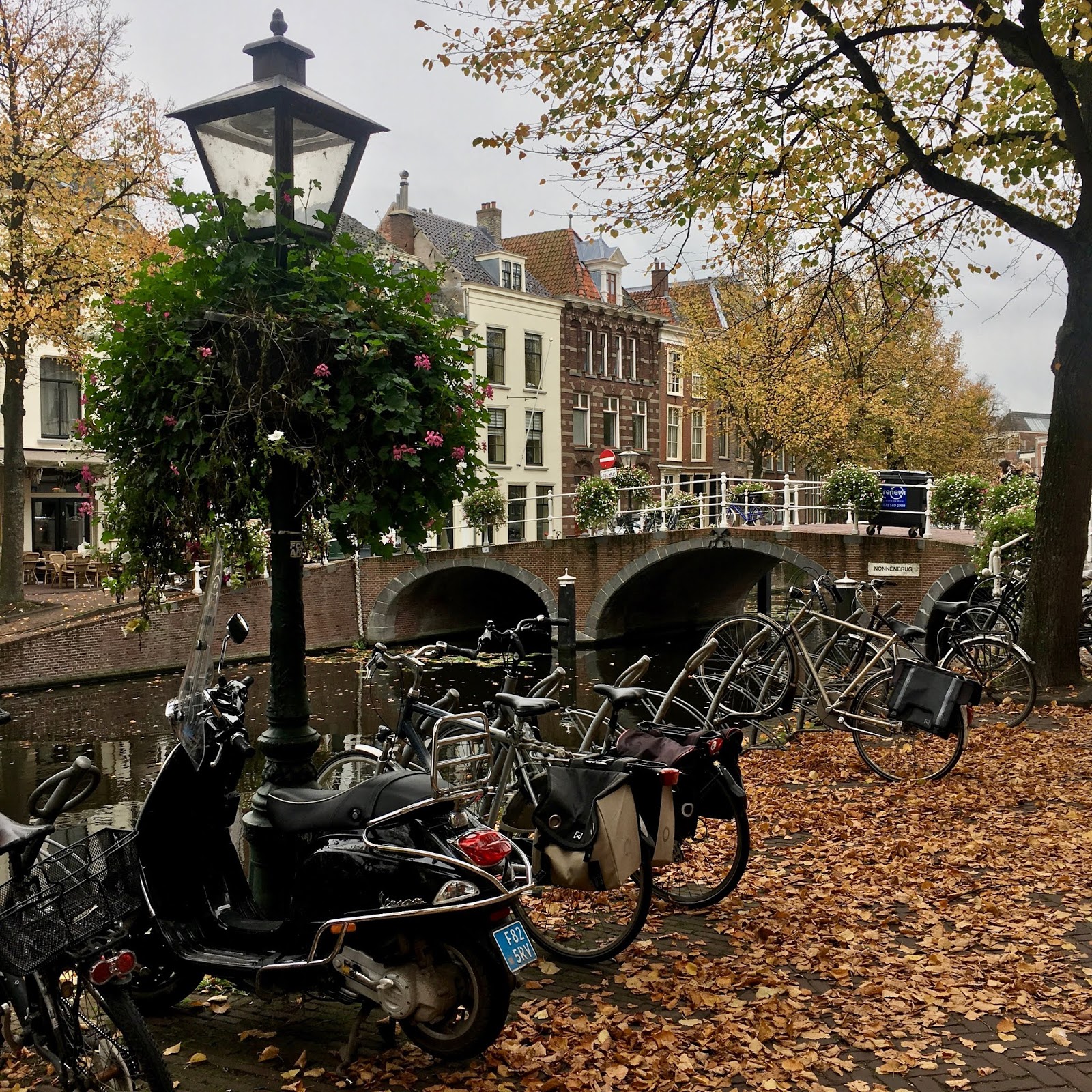
Expat daughter and I had done our homework and googled Netherlands' population of 17 million people. We knew that they were the world's No.1 bikers but what we didn't know is that all together the Dutch own 22.5 million bicycles. This means that on average they own 1.3 bicycles per capita. More than any other country in the world.


One of the more spectacular products of the bike-train system is this sea of bicycles you see at any train station in the Netherlands


Almost a quarter of the Dutch population cycles every day.


Less than 0.5 percent of Dutch cyclists wear helmets...


... it’s just not present in their culture, because they’ve ultimately decided that it’s far more important to build this culture of everyday cycling, and to build safe streets, instead of requiring people to protect themselves.


For decades, the Dutch have had a country-wide network of bicycle trails. You can get from one city to another on a bike, no matter the distance. 


The bike is an integral part of everyday life rather than a specialist's accessory or a symbol of a minority lifestyle, so Dutch people don't concern themselves with having the very latest model of bike or hi-tech gadgets.


Cycling is so common that when you ask people whether they are cyclists or not, their response is: "We aren't cyclists, we're just Dutch."!


The Dutch regard their bikes as trusty companions in life's adventures. In that kind of relationship it is longevity that counts - so the older, the better.


The fact that everyone cycles, or knows someone who does, means that drivers are more sympathetic to cyclists when they have to share space on the roads.


Utrecht built the Netherlands’ first bike lane in 1885. 


The average speed of the Dutch on a pedal bicycle is 12.4 km/h...


... and the average speed on an e-bike is 13 km/h.


Come give it a try!

July 28, 2019

A dress fit for a princess

Add Madrid to girlfriends and fashion and it is guaranteed to equal fun! Following a group whatsapp proposal four chirpy ladies headed to the Thyssen museum to discover what connected the work of Cristobal Balenciaga, the most admired and influential fashion designer of all times, with the tradition of 16th to 20th-century Spanish painting.

I have visited a few Balenciaga exhibits in Paris over the years but this one was unique. Who knew that references to Spanish art and culture are a recurring presence in Balenciaga’s work? Over a span of five decades he managed to revive historic garments and reinterpret them in a strikingly modern manner.

We admired over 90 items of clothing and accessories and 50 paintings of great names of Spanish art, such as El Greco, Velázquez, Zurbarán and Goya, all inspiring the work of the influential Basque fashion designer. This explosive cocktail combining talent and colours caught all our admiration of the beauty of creativity and the detail in exquisite handcraft.

All four of us wondered where the clothes had come from? It seems some of the Balenciaga pieces on display were lost and then resurfaced. The name of Hamish Bowles intrigued us. A quick google to discover he is a fashion collector extraordinaire who loaned some of his discoveries, including a flower-embroidered top he first saw at the age of 12, when it was auctioned off for £60 at a jumble sale.

Apparently the thirteen masterpieces from the Prado are so exceptional that they cannot leave Spain, or in one case cannot even leave the palace. So it’s impossible for the exhibition to travel. The insurance is so high! Therefore my suggestion would be: gather some girlfriends and have yourself a jolly outing to Madrid... it is worth it!


Ignacio Zuloaga's "Portrait of María del Rosario de Silva y Gurtubay, Duchess of Alba" behind a taffeta evening gown from 1952 and echoed in the flounces of a pink cocktail dress - my personal favourite!


Stunning Francisco de Goya, "Cardinal Luis Maria de Borbón y Vallabriga" against a satin dress and jacket with metallic thread, sequins and ceramic beads (1960)


Juan Carreño de Miranda’s portrait of Doña María de Vera y Gasca and Balenciaga's modern reinterpretation of the Velázquezian shape


"Christ Blessing" by El Greco magnificently reflected in pink and blue evening dresses


El Greco's "The Annunciation" against evening gowns in silk organza (1968)


Jet-black dresses presented with a dense, dark painting by El Greco


The Portrait of the VI Countess of Miranda mirrored in a satin evening gown from 1943


Rodrigo de Villandrando's "Isabel de Borbón, Wife of Philip IV"  was the inspiration to a 1957 wedding dress of silk shantung embroidered with silver thread


An exquisite detail of craftsmanship 


Cristobal Balenciaga (1895-1972), the designer who Christian Dior defined as “the master of us all”


Far left, a satin and mink wedding dress that Balenciaga made for Queen Fabiola of Belgium in 1960, set against portraits by Francisco Zurbarán (1628-34)


Goya's "Queen María Luisa in a dress with hooped skirt" reinventing into an evening gown of satin, pearls and beads from 1963


Antonio María Esquivel's "The Dancer Josefa Vargas" frivolously retaylored into a taffeta and embroidered cotton trim cocktail dress from 1955


The Thyssen-Bornemisza National Museum displays over 1,600 paintings. It was once the second largest private collection in the world after the British Royal Collection and was initially housed in the family estate in Lugano until 1988 when the request for building a further extension by Baron Thyssen was rejected by the City Council.
Related Posts Plugin for WordPress, Blogger...