January 23, 2012

Visiting an empty French Senat

“When they call the roll in the Senate, the Senators do not know whether to answer "Present" or "Not Guilty."”
Theodore Roosevelt

The other day, I followed the proposal of a very well-organized lady to join her on the tour of the Palais du Luxembourg, home of the French Senat. I figured it would be very instructive. The tour was impressive due to the lovely building and it's interior design. You could feel the "Grandeur des Français" of past times throughtout the whole tour.

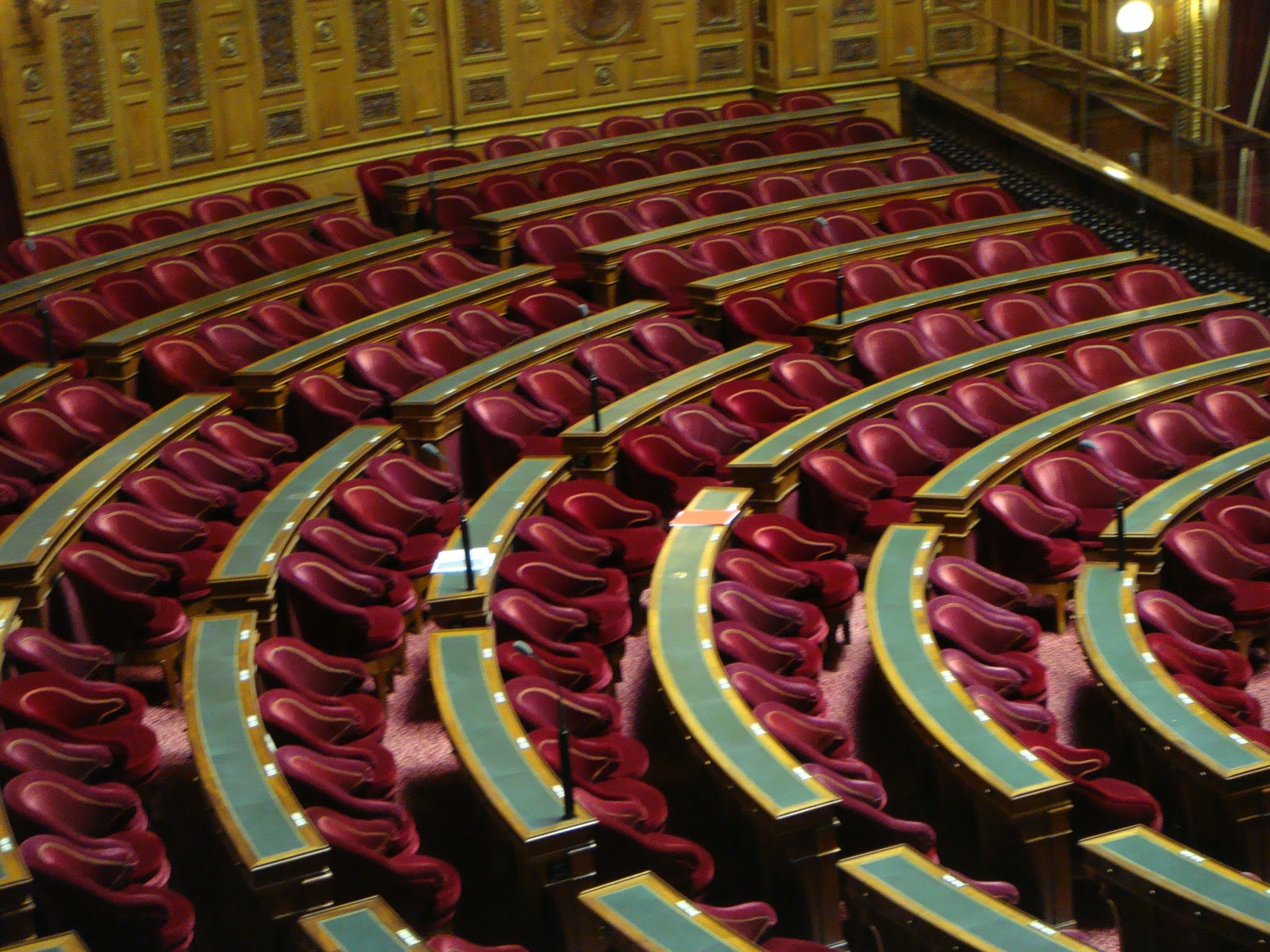
I was not impressed when we reached the Chamber of Sessions just to find it empty. Guess what, it's Friday and no senators are to be seen. Usually there are 343 senators who are assisted by specialised civil servants and parliamentary aides. In all, 2000 people work here. We didn't get to see many of them!!! Nobody was able to explain why the all the senators had the day off... not even our charming guide, Frank!


Our guide, Frank ... très francais!

The French Parliament is made up of two chambers, the National Assembly and the Senate. Members of the two Houses are chosen by two different electoral systems. This ensures that all the diverse components of French society are represented as fairly as possible.

Examination of bills by both Houses of Parliament makes for better laws and the well proven experience of the Senators improves their content.

The Speaker of the Senate ensures the stability of France’s institutions as he is called upon to replace the President of the Republic in the event of his death or resignation.

But lets come back to the Palais de Luxembourg. Marie de Medici (wife of Henri IV of France ) bought the land on which the Palace now sits and started plans for the building in 1612. Up until the French Revolution it was a princely residence.

Declared a National Palace in 1791, the Luxembourg Palace became home to the Directoire, the House of Peers (1814-1848), and the Senate of the Third Republic (from 1879).


feeling the French vibes


the golden room


Yours truly ... reporting


I'd like to have a staircairs like this at home ....


impressive hallway ...


the one and only senator to be found ... having a photo session

good work guys


no senators, no spectators


unfortunately we were not allowed to enter this impressive library


waiting for Cinderella to enter through the door


in the meantime ... I'll have a rest


January 21, 2012

My new French number plates

“Bureaucracy is the art of making the possible impossible”
Javier Pascual Salcedo

There is something about changing one's number plates that make a move feel definite. After weeks or rather months of adapting, settling in and filing endless paper work for any document under the sun, giving up the number plate of your former "home" country always has an air of final, unconditional no-going-back-to-the-past about it.

Five years ago I trekked down to Bellinzona from Lugano to get my Swiss number plates. I remember being so incredibly proud of my Ticinese plates. Not only did it make me feel local but having grown up in Zurich, my belief was that a car with TI number plates was just plain cool!!!

I admit it was sad seeing the Spanish number plates go, nevertheless!

Two days ago, I was sitting at the "prefecture de police" of Paris which I had to walk to because the metro broke down. I did, however, manage to avoid stepping on a rat while coming put of the metro station.


Impressive police station!


It took all of 17 minutes to do the paperwork ... and I had had visions of me spending all day fighting French bureaucrats. I was beginning to wonder if the Swiss administration had some serious competition? Alas, you don't receive the number plates along with your "carte grise", you are, however, allocated a number.

You then need to find a garage or a cobbler who will print your allocated number on a pair of plates within 48 hours. Strange system if you ask me. I'm wondering at this point "where does the insurance fit in with procedures?"

Being Swiss at heart I decide to call my car concessionary who is scandalized by the fact I even considered ordering number plates on line (another option) and gives me an appointment for the next day.

Racing against the clock I decide on an insurance et voilà ... today I am the proud owner of a Parisian number plate. I can already hear the local Swiss drivers cursing at me when we spend our ski holidays back home!!!!!

Before


After


January 17, 2012

Exploring Paris' history

How do a Swedish American, a Jewish American, a Japanese American and a Swiss American go about learning Paris' rich history? Well, we took ourselves off to the Musée Carnavalet in the Marais district.

We initially got sidetracked by a little cafe while waiting for the museum to open. Un petit déjeuner and a good girlie conversation later, we set off to explore the Museum of the History of Paris.

Can you believe that until the end of the 19th century, the City of Paris did not have a single museum? From 1797, the majority of national collections were displayed to the public in the Museum, the current Louvre, with the remainder assigned to the Museums of Fine Arts of large Provincial cities.

The Museum of the History of Paris is located at the heart of Le Marais, one of the few districts whose architectural heritage was spared by the major transformation projects of Haussmann. Even today it still offers plenty of evidence of its extremely rich past: town houses (sometimes with their decors), gardens, religious buildings, etc. For this reason, Le Marais has been a protected area since 1965.

The Hôtel Carnavalet is one of the rare examples of Renaissance architecture in Paris, alongside the Louvre’s square courtyard. Built from 1548 to 1560 for Jacques des Ligneris, president of the Parliament of Paris, it is one of the oldest hotels in Le Marais. In 1578 the hotel received its current name, stemming from a distortion of the name of its following owner, Madame de Kernevenoy of Brittany.


Behind the somewhat mysterious name of Musée Carnavalet lies hidden one of the capital’s most genuinely Parisian museums. The oldest of the municipal museums tells the story of Paris from a bygone era (a prehistoric dugout canoe dating from 4600 BC) to the present day, in all its immense variety.


Courtyard Statue


Shopkeepers, whose customers were often illiterate, attracted the attention of passing trade by shouting their wares, but also by using pictures and scale models.


Jean Babtise Deshayes
1729 - 1765
"Minerva presenting peace to the City of Paris"
And this was just a sketch that he presented to the City of Paris


There is even a pink room!


The chair where Victor Hugo had his inspiration as well as his last breath.


Galerie d'exposition 1929


Scale model of the Bastille


Declaration of citizens' rights


January 15, 2012

Wine and cheese tasting the French way

I was lucky to be invited to French wine and cheese tasting evening last Friday. At a friend's home overlooking the sparkling Eiffel Tour we gave our tastebuds a treat they should never forget.


I thought I'd let you in on to some secrets of wine tasting.

Learning how to taste wines is a straightforward adventure that will deepen your appreciation for both wines and winemakers. Look, smell, taste - starting with your basic senses and expanding from there you will learn how to taste wines like the pros in no time! Keep in mind that you can smell thousands of unique scents, but your taste perception is limited to salty, sweet, sour and bitter. It is the combination of smell and taste that allows you to discern flavor.

1.) Look: Check out the Color and Clarity.
Pour a glass of wine into a suitable wine glass. Then take a good look at the wine. Tilt the glass away from you and check out the color of the wine from the rim edges to the middle of the glass.

2.) Still Looking. Move on to the wine's opacity. Is the wine watery or dark, translucent or opaque, dull or brilliant, cloudy or clear? Can you see sediment? Tilt your glass a bit, give it a little swirl - look again, is there sediment, bits of cork or any other floaters? An older red wine will often have more orange tinges on the edges of color than younger red wines. Older white wines are darker, than younger white wines when comparing the same varietal at different ages.

3.) Smell:
Our sense of smell is critical in properly analyzing a glass of wine. To get a good impression of your wine's aroma, swirl your glass for a solid 10-12 seconds (this helps vaporize some of the wine's alcohol and release more of its natural aromas) and then take a quick whiff to gain a first impression.

4.) Still Smelling. Now stick your nose down into the glass and take a deep inhale through your nose. What are your second impressions? Do you smell oak, berry, flowers, vanilla or citrus? A wine's aroma is an excellent indicator of its quality and unique characteristics. Swirl the wine and let the aromas mix and mingle, and sniff again.

5.) Taste:
Finally, take a taste. Start with a small sip and let it roll around your mouth. There are three stages of taste: the Attack phase, the Evolution phase and the Finish.

6.) The Attack Phase, is the initial impression that the wine makes on your palate. The Attack is comprised of four pieces of the wine puzzle: alcohol content, tannin levels, acidity and residual sugar. These four puzzle pieces display initial sensations on the palate. Ideally these components will be well-balanced one piece will not be more prominent than the others.

7.) The Evolution Phase is next, also called the mid-palate or middle range phase, this is the wine’s actual taste on the palate. In this phase you are looking to discern the flavor profile of the wine. If it’s a red wine you may start noting fruit – berry, plum, prune or fig; perhaps some spice – pepper, clove, cinnamon, or maybe a woody flavor like oak, cedar, or a detectable smokiness. If you are in the Evolution Phase of a white wine you may taste apple, pear, tropical or citrus fruits, or the taste may be more floral in nature or consist of honey, butter, herbs or a bit of earthiness.

8.) The Finish is appropriately labeled as the final phase. The wine's finish is how long the flavor impression lasts after it is swallowed. This is where the wine culminates, where the aftertaste comes into play. Did it last several seconds? Was it light-bodied (like the weight of water), medium-bodied (similar in weight to milk) or full-bodied (like the consistency of cream)? Can you taste the remnant of the wine on the back of your mouth and throat? Do you want another sip or was the wine too bitter at the end? What was your last flavor impression – fruit, butter, oak? Does the taste persist or is it short-lived?

9.) After you have taken the time to taste your wine, you might record some of your impressions. Did you like the wine overall? Was it sweet, sour or bitter? How was the wine's acidity? Was it well balanced? Does it taste better with cheese, bread or a heavy meal? Will you buy it again? If so, jot the wine's name, producer and vintage year down for future reference.

But never forget, wine tasting is only fun if shared! So why not gather your buddies, find a specialized wine merchand or shop and organize an entertaining evening for your friends.


Source: about.com


January 11, 2012

A suprise in the metro

“Small rooms or dwellings discipline the mind, large ones weaken it.”
Leonardo Da Vinci

On my way across the city this morning I had to stop at Metro Auber where much to my suprise IKEA had set up an appartment shared by five roommates. Until January 14th you can peek at IKEA's  initiative to showcase development solutions for small areas.

Just another curious occurence in my Parisian life....


January 9, 2012

Defying the Parisian dress code

"Always be a first-rate version of yourself, instead of a second-rate version of somebody else."
Judy Garland

I did it! I finally did it! I defied all Parisian fashion codes and dropped off my daughter at school wearing my running gear rather than black miniskirt and high heeled boots!!!
What a great feeling. I am back to my old self. Don't get me wrong, I love to dress nicely. My friends will confirm that I am close to beating a new record when it comes to pairs of shoes, however, I do need that jog first thing in the morning to get started even if it is with red painted fingernails and lipstick!

If the Bois de Boulogne overflows with people during the weekend, it was a pleasure to jog along the two little lakes this morning. Just see for yourself.


January 7, 2012

Parisian excercise classes

Call me spoilt but it is too much to ask for a modern, airy, clean health club with a parking? Apparently in Paris it is. Space is a luxury that cannot be wasted in the city of lights. After having checked out various gyms in the city center and discovering that not only were they underground and minute but that the ventilation was minimal and the number of active members hefty, I decided just to continue jogging along les avenues de Paris until it got too cold.

Well, now that this moment has come, I have launched myself into joining an excercise class. The main reason I chose this particular one is that is located closest to home. Walking up to the address, I crossed two petite very tanned and VERY toned French ladies wearing very sexy purple Victoria's Secret yoga outfits. Just in case you're wondering at this point; I am on Victoria's Secret mailing list. ;)

I thought to myself: "If these ladies are heading to the same place I am, this must be the right spot."


Sure enough, the premises - tucked away at the end of a Parisian internal courtyard - were cosy, clean and well organized. It is not a gym just a ballet/excercise studio but I enjoyed the International atmosphere (a nice change from the Parisian pomp). I must admit, however, I was happy I had my nails polished bright red to make up for my rather unsexy running gear!


The class was a combination of ballet barre work, core conditioning, muscle strengthening, yoga, and orthopedic exercises. My entire body and mind was constantly working throughout class. Note that I am NOT a big lover of classes!

By the end of the 60 minute workout - and a good workout it was - I signed up for the month. I will never be able to compete with the French ladies but a day later I can feel every single muscle in my body, so the instructor must have done a good job!!!

January 5, 2012

La Galette des Rois - homemade!

Reyes Magos, Epifany, La Befana, Three Kings Day...International family means International traditions! I do admit we pick and choose our celebrations. January 6th has found its place in our household as "Los Reyes Magos". Mainly because we lived in Madrid when the kind caught on to the fact that in Spanish tradition the three kings bring the kids all their presents rather than Father Christmas. Add 2 plus 2....pressies for Christmas plus regalos for "Los Reyes Magos".

However, we now live in Paris, therefore I have decided to give our family tradition a twist by baking the typical French dessert bread called "La Galette des Rois" in preparation for tomorrow.

"La Galette des Rois" (the cake of the three kings), a cake made of frangipane (almond cream paste) and a buttery crust, is sold in patisseries all over France. These delicious cakes celebrate the Feast of the Epiphany. Many boulangeries now do different flavors besides the traditional almond including raspberry, pistachio, and chocolate. The cake is usually sold with a gold paper crown.

Here is how to make it yourself! Give it a try. It is really fast and easy.


La Galette des Rois (Serves 8)

Ingredients:
1 1/4 lb frozen puff pastry
2 eggs
7 oz almond paste

Preparation:
Leave the puff pastry at room temperature for about 2 hours until defrosted but still cold.
Preheat the oven to 400°F.

Line a baking sheet or pizza pan with baking parchment or grease the pan and lightly sift flour on it. Shake off any excess flour. Roll each sheet of pastry into a circle about 12 inches across. Place one circle on the prepared pan.

Mix the egg with the almond paste until smooth and spread the mixture evenly on the prepared circle of pastry, leaving a border 1 1/2 inches wide all around. If you have a small piece of china, insert it into the almond mixture (you may also use a bean as the fève.) The person who gets the fève is the King or Queen for the day.

Place the second circle of pastry on top and press it down tightly around the rim.

Beat lightly the remaining egg and brush it on the top of the cake. With a long-bladed knife, press lightly but firmly through the egg glaze marking a crisscross pattern.

Bake for 20–25 minutes until golden and puffed. Do not check for doneness for at least 15 minutes, as the pastry may collapse. Serve slightly warm or cold.

Easy peazy!!!

January 4, 2012

Following Leonardo da Vinci's footsteps...

It has been a while....

Over time this blog has evolved as a "resumé" of my adventures in France. It is not a diary since there is no way I can keep up with logging in on a daily basis. However, I hope that a few years down the road - when we will be further expatriated somewhere around the globe - I will read though my Paris blog and wade in fond memories.

In order to show my kids that our adventure is not "just" about Paris but that there is more to France, I decided to take them off on a "tour de force". We only had five days since school started relatively early this year.

We visited the Loire Valley, Brittany and added a quick stop in Normandy. Following are some impressions of our first stop in the Loire Valley.


Chateau de Chambord


The royal Château de Chambord is one of the most recognizable châteaux in the world because of its very distinct French Renaissance architecture which blends traditional French medieval forms with classical Renaissance structures.


Chambord is the largest château in the Loire Valley. It was built to serve as a hunting lodge for François I, who maintained his royal residences at Château de Blois and Château d'Amboise. The original design of the Château de Chambord is attributed, though with several doubts, to Domenico da Cortona. Trust the Italians, they are all over the place!

Some authors claim that the French Renaissance architect Philibert Delorme had a considerable role in the château's design, and others have suggested that Leonardo da Vinci may have designed it. More Italian influence!!!


The roofscape of Chambord contrasts with the masses of its masonry and has often been compared with the skyline of a town. It shows eleven kinds of towers and three types of chimneys, without symmetry, framed at the corners by the massive towers. The design parallels are - must I repeat- north Italian and Leonardesque.


View onto Chateau d'Amboise from Clos Lucé


Who knew that Leonard da Vinci spent his last years in Amboise?


Clos Lucé is a mansion in Amboise, France, located 500 metres from the royal Château d'Amboise, to which it is connected by an underground passageway. Built by Étienne le Loup in the middle of the fifteenth century, it was acquired in 1490 by Charles VIII of France for his wife, Anne de Bretagne. Later, it was used by Francis I, as well as his sister Marguerite de Navarre, who began writing her book entitled L'Heptaméron while living there.


In 1516, Francis I invited Leonardo da Vinci to Amboise and provided him with the Clos Lucé, then called Château de Cloux, as a place to stay and work.[1] Leonardo, a famous painter and inventor, arrived with three of his paintings, namely the Mona Lisa, Sainte Anne, and Saint Jean Baptiste. Leonardo lived at the Clos Lucé for the last three years of his life, and died there on 2 May 1519.


The village of Amboise


View down the valley with a glimps of our hotel


Grounds of Chateau d'Amboise 


Soaking in the sunshine and enjoying the blue skies


An "Out of Africa" moment


Related Posts Plugin for WordPress, Blogger...